Maritime Auditory Intelligence — Datathon 2026
End-to-end maritime intelligence platform processing 171,750 incidents with six specialised ML models. Awarded 2nd place at the ITG & Universidade da Coruña Datathon 2026.
Visit websiteThe Challenge
Maritime incident data is heterogeneous, high-volume, and temporally sparse — combining AIS vessel tracking, incident reports, and regulatory records across 171,750 events. The goal was to build a unified intelligent platform capable of predictive incident management, early warning, and real-time risk prioritisation.
Six Specialised ML Models
| Model | Task | Algorithm | Performance |
|---|---|---|---|
| Anomaly Detection | Irregular behaviour | XGBoost | AUC-ROC 0.964 |
| Risk Classification | Multi-level risk scoring | Random Forest | F1 weighted 0.891 |
| Incident Typing | Event categorisation | XGBoost | F1 macro 0.956 |
| Cost Regression | Financial impact | Gradient Boosting | R² = 0.70 |
| Temporal Prediction | Time-series forecasting | Prophet | — |
| Geographic Clustering | Hotspot identification | HDBSCAN | — |
Next.js Interactive Dashboard
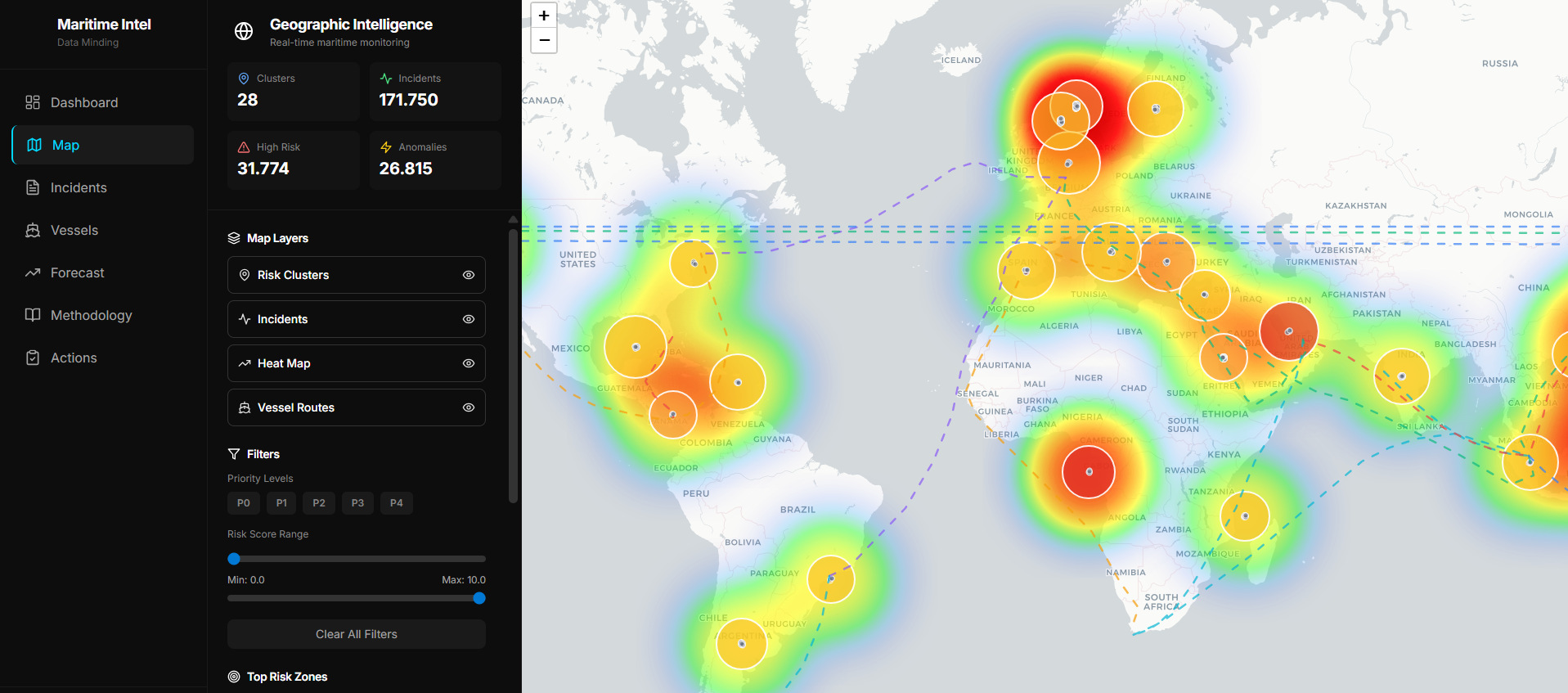
The platform ships with an interactive Next.js dashboard for real-time incident exploration, geographic hotspot visualisation, and action prioritisation. Incidents are classified across severity levels P0–P4, enabling responders to triage critical events instantly.
Stack: Python · XGBoost · scikit-learn · Prophet · HDBSCAN · Next.js · AIS data · Pandas
Key Outcomes
- Awarded 2nd place at Datathon 2026, ITG & Universidade da Coruña
- Anomaly detection with AUC-ROC 0.964 on 171,750 heterogeneous AIS incidents
- Full regulatory compliance pipeline with multi-tenant data isolation
- Geographic clustering reveals persistent risk hotspots across shipping lanes